HS Code vs HTS Code: What’s the Difference in International Shipping?
HS Codes and HTS Codes
Between understanding Incoterms®, selecting shipping methods and containerisation, preparing essential documentation and staying on top of customs and compliance, anyone new to the logistics industry would feel overwhelmed.
Harmonised System (HS) Codes and Harmonised Tariff Schedule (HTS) Codes are classification systems used to identify and categorise goods in international trade. These are essential codes that help customs authorities identify the products being shipped quickly and apply the appropriate tariffs on the cargo.
As the tariff landscape shifts with the changes in the US’s recent tariff implementations, it’s very important to use the correct codes to ensure that your cargo doesn’t get hit with the wrong tariffs.
In this article, we’ll be reviewing the key differences between HS Code and HTS Code and why it’s important to use the correct codes when shipping internationally. Understanding these codes helps reduce the risk of customs delays and incorrect duty charges.
If you’re looking for more clarity about Incoterms®, read our article highlighting all the important information about the rules, why they came to be and the importance of using them.
What is an HS Code?
The Harmonised System (HS) Code is administered by the World Customs Organisation (WCO) and is updated every five years – with the 2022 edition (7th edition) being the most recent major revision produced. The Harmonised System assigns six-digit codes that are unique to each commodity or raw product. Countries are allowed to add more digits to the HS Code for further classification of the goods.
According to the World Customs Organisation, more than 200 countries and economies use HS Codes to standardise their customs tariffs. While the HS Code helps to track not only customs tariffs, its primary aim is to help standardise global trade operations.
The HS Code provides unified categorisation for the classification of various types of goods which helps to minimise misunderstandings of product classifications across different countries. This standardisation allows for a smoother trade process.
To note: when preparing export documents, the Harmonised System (HS) code – the first six-digits) is used for international, universal classification of the goods. But, if you are exporting from the United States, the ten-digit Schedule B Code must be used for reporting to the Census Bureau.
What is an HTS Code?
The Harmonized Tariff Schedule (HTS) used in the United States is maintained by the U.S. International Trade Commission (USITC). This code is the seven to ten-digit import classification system used in the United States that provides tariff rates and statistical data for goods imported into a country. This ten-digit code is based on the HS Code. This means that the first six-digits of the HTS Code will align with the universal HS Code, ensuring standardisation and consistency for the first part of the classification.
The seventh to the tenth digit of the HTS code are specific to the importing country, providing a more in-depth classification as per national requirements. For example, the U.S. International Trade Commission (USITC) publishes the ten-digit Harmonised Tariff Schedule of the United States (HTSUS).
Unlike the revisions for the HS Code, the HTS Code is frequently revised, often multiple times in a year, to reflect trade agreements, duty changes, and technical corrections. As of February 2026, the HTSUS has been revised four times and is expected to continue being revised due to ongoing trade policy updates and tariff changes.
Having a good understanding of HTS Codes is especially important for businesses engaging in international trade. If you’re importing to the U.S., it’s essential to keep up to date with the latest HTS Code revisions – it provides an accurate estimate of customs duties applicable upon importing goods into the U.S. and it’s also a code that you must use when importing.
What are Schedule B Codes?
In addition to HTSUS Codes, the United States also uses Schedule B Codes. The Schedule B Code is maintained by the U.S. Census Bureau and is used for U.S. export reporting via Automated Export System (AES).
The Schedule B Code is only used for U.S. exports – it’s a ten-digit code, with the first six-digits following the HS product classification, and the last four-digits indicating the export information.
Essentially, HTSUS Codes are for tracking imports and Schedule B Codes are for tracking exports for the United States. These codes are distinct and cannot be used interchangeably for exporting or importing purposes. For example, a Schedule B Code cannot be used when importing goods into the United States.
Breaking Down The Differences Between HS Code and HTS Code
To those new to logistics, a HS Code and a HTS Code will seem indistinguishable on paper. But, let’s break down the main differences.
Quick Comparison:
- HS Code: International classification (six-digits)
- HTS Code: U.S. import tariff classification (ten-digits)
- Schedule B: U.S. export classification (ten-digits)
In-depth Breakdown:
- Scope: HS Codes are used internationally, whereas HTS Codes are country-specific. HTS Codes have country-specific extensions – these tend to range from two to four-digit additions to the base six-digit HS Code to create their own tariff schedule. For example, the United States uses a ten-digit HTSUS Code.
- Length: HS Codes are six-digits long. On the other hand, HTS Codes are typically ten-digits long.
- Purpose: The purpose of the HS Code is to identify what the product classification is. Meanwhile, the HTS Code determines how the product is treated in terms of what duty rate, taxes or trade restrictions are imposed on it.
- Usage: HS Codes are used for export declarations and basic classification of the product, and HTS Codes are used specifically for import declarations.
- Update Frequency: The HS Code is typically updated every 5 years but the HTS Code is updated multiple times in a year.
HS Code Structure and HTS Code Structure
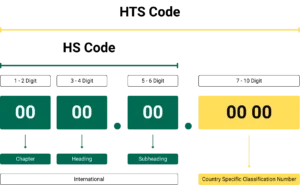
The HS Code structure has 4 main components. Below is a breakdown of the structure and each component:
Chapters (First Two Digits):
The Chapters are the first two-digits of the code. This helps to define the general category of the product. For example, Chapter 85 is the category for Electrical Machinery and Chapter 84 is for Machinery/Computers.
Headings (Digits Three and Four):
The Headings are the third and fourth digits in the code. This helps to provide more specific detail about the product group within the chapter. For example, 8542 is for Electronic Integrated Circuits.
Subheading (Digits Five and Six):
The Subheadings are the fifth and sixth digits in the code. This helps to provide further granular classification based on type or use. For example, 8542.31 is for processors and controllers, whether or not combined with memories, converters, logic circuits, amplifiers, clock and timing circuits, or other circuits.
National/Regional Extensions (Digits Seven to Ten):
These are the additional digits for specific country duties, such as the eight-digit ASEAN Harmonised Tariff Nomenclature (AHTN) or ten-digit U.S. HTSUS. For example, the HTSUS Code 8542.31.0015 indicates that the product is categorised as an 8-bit microprocessor, and will have country-specific duties and taxes implemented on it when importing it into the U.S.
The HS Code’s clear structure allows for a systematic and standardised classification of goods worldwide, making international trade processes, tariff implementations and tracking easier.
HS Codes in ASEAN: Understanding AHTN
The ASEAN Harmonised Tariff Nomenclature (AHTN) is an eight-digit code used by all 10 ASEAN member states to classify products for customs, trade and statistical purposes. The first six-digits in the AHTN Code follows the HS Code and the last two-digits add more accuracy within Southeast Asia.
How to Find the Correct HS Code List?
To find the HS Code for a product, you can use official sources like the WCO Trade Tools or government customs databases – such as Singapore Customs (SC) HS/CA Product Code Search Engine.
How to Find The Correct HTS Code List?
To find the HTS Code for a product, you can use official sources like the U.S. International Trade Commission (USITC) HTS search for U.S. imports or Singapore Customs HS/CA Product Code Search for Singapore Trade.
Enjoy Seamless Logistics Solutions with Halcon Primo Logistics
Halcon Primo Logistics provides end-to-end logistics solutions – ensuring your cargo gets where it needs to go efficiently, reliably and on time.
Correct product classification is essential to avoid customs delays, incorrect duties, and compliance risks. Working with an experienced logistics partner ensures your shipments are classified correctly and cleared efficiently.
With the ongoing changes in logistics and international trade, it’s important to have a dependable logistics partner to weather through storms during turbulent times. With our expertise and regional presence, we are able to offer scalable, flexible and dynamic logistics solutions that ensure your supply chain runs smoothly.